

Women’s Rights in a Joint Hindu Family: Coparcenary, Succession, and Maintenance under Hindu Law
Introduction
When discussing family laws in India, it is essential to understand that the smallest unit of society is the family. A single individual cannot constitute a family; there must be at least two people. A family traditionally begins with a common male ancestor. While this ancestor is crucial for the establishment of the family, they do not need to be present for the family to continue to exist.
In the case of a joint Hindu family, the presence of a common male ancestor, along with his lineage and dependents, is necessary for its formation. It is important to note that a common household is not required for a joint Hindu family to exist. However, the members must share a blood relationship and a bond of love and affinity. There are various aspects of sharing within a joint Hindu family, one of the most significant being the blood relationship. Additionally, members of a joint Hindu family share meals and participate in worship together. If a member ceases to adhere to the specific faith, they may no longer be considered part of that joint Hindu family. Nonetheless, if family members do not live in the same household but continue to share meals and worship together, their status as members of a joint family remains unchanged. The devolution of the ancestor’s property will still recognise that separate living member as part of the family.
All rights related to property, succession, and inheritance stem from this common ancestor. Your identity and entitlement to succeed to property or inheritances arise from being part of this smallest unit, which is the joint Hindu family. Historically, women did not have the right to inherit property solely by virtue of being female. However, following an amendment to the Hindu Succession Act in 2005 and subsequent landmark judgments in 2016 and 2018, women were granted the right to hold and inherit property.
Status of a woman in a Joint Hindu Family prior to the 2005 Amendment
A joint Hindu family consists of all male members descended lineally from a common male ancestor, along with their wives, widows, mothers, and unmarried daughters. The common male ancestor and all his male lineal descendants up to three generations were referred to as coparceners. A coparcenary primarily establishes a right by birth, which applies to the son, the son’s son, and the son’s son’s son.
According to the definition of coparcenary, individuals who do not have any birthright within this structure include wives, mothers, unmarried daughters, and widows, as they are not born into this lineage. Wives, widows, unmarried daughters, and mothers were considered members of the coparceners’ family.
An unmarried daughter, or a daughter until she gets married, was part of her father’s joint Hindu family. However, once she marries, she becomes a member of her husband’s joint Hindu family. If she becomes a widow or is deserted, she regains the status of an unmarried daughter. In this case, she has the option to return and rejoin her father’s joint Hindu family if she so wishes.
Coparcenary and Women’s Rights after the Hindu Succession (Amendment) Act, 2005[1]
Traditionally, under Mitakshara law, only male members of a joint Hindu family could be coparceners. The rights of coparceners were governed by the doctrine of survivorship, under which property passed automatically to surviving male members upon the death of a coparcener.
This position underwent a transformational change with the Hindu Succession (Amendment) Act, 2005[2], particularly through the substitution of Section 6[3]. Section 6 now provides that a daughter of a coparcener shall, by birth, become a coparcener in her own right, in the same manner as a son. She has the same rights, liabilities, and entitlements in the coparcenary property as a son.
This amendment removed gender-based discrimination and recognised daughters as equal stakeholders in ancestral property. The concept of survivorship was also diluted, and the property of a deceased coparcener now devolves through testamentary or intestate succession, rather than automatically passing to male heirs.
Property of a Female Hindu: Absolute Ownership
Another significant provision affecting the status of women is Section 14[4] of the Hindu Succession Act, 1956. Section 14(1) states that any property possessed by a female Hindu, whether acquired before or after the commencement of the Act, shall be held by her as absolute property and not as a limited owner.
This provision abolished the concept of “limited estate” or “widow’s estate” that existed under traditional Hindu law. Once a woman acquires property, whether through inheritance, partition, maintenance, gift, or otherwise, she becomes its full owner with unrestricted rights of alienation.
The Supreme Court has consistently interpreted Section 14 liberally to advance the objective of women’s economic empowerment. In the case of Kallakuri Pattabhiramaswamy (Dead) Versus Kallakuri Kamaraju & Ors[5], the Supreme Court held that a Hindu woman becomes the absolute owner of property only when it is given to her in recognition of a pre-existing right, such as maintenance under Section 14(1) of the Hindu Succession Act, 1956. Where property is granted merely as a life interest without any antecedent right, Section 14(2) applies, and such property does not convert into absolute ownership. The Court thus clarified the distinction between a limited estate and absolute ownership of property held by Hindu women.
Self-Acquired Property vs Ancestral Property
Self-acquired property is property that a person acquires through their own efforts, such as earnings, gifts, or property purchased independently. Such property is not subject to the doctrine of survivorship and can be freely disposed of through a will under Section 30[6] of the Act.
Self-acquired property can be understood in two contexts: interstate succession and testamentary succession. In testamentary succession, a person specifies in their will how their property will be distributed, for example, by giving it to their son or daughter.
Interstate succession occurs when a person dies without leaving a will. In this situation, the deceased person’s property is divided into two categories: ancestral property, inherited from ancestors, and self-acquired property, obtained through the individual’s own efforts.
Under the rules established in Sections 8 to 13[7]Both self-acquired and ancestral property are distributed similarly in cases of intestate succession. Although they remain legally distinct, the distribution rules treat self-acquired property similarly to inherited property when there is no will. Thus, in the context of interstate succession, both types of property are handled comparably.
Intestate Succession and Distribution of Property
When a Hindu dies intestate (without a will), succession is governed by Chapter II of the Hindu Succession Act, 1956[8].
Under Section 8, the property of a male Hindu dying intestate devolves upon Class I heirs listed in the Schedule, which includes:
- Son
- Daughter
- Widow
- Mother
If Class I heirs are present, no one else can inherit the property. Section 10 lays down the manner of distribution, where all Class I heirs take equal shares.
Importantly, after the 2005 amendment, daughters stand on the same footing as sons, not only as heirs but also as coparceners in cases involving ancestral property.
Landmark Judicial Pronouncements
Vineeta Sharma v. Rakesh Sharma (2020)[9]
In this landmark judgment, the Supreme Court clarified that a daughter’s right as a coparcener is by birth and does not depend on whether the father was alive on the date of the 2005 amendment. The Court held that daughters have equal coparcenary rights in ancestral property irrespective of when they were born. The judgment harmonised Section 6 of the Hindu Succession Act with Articles 14 and 15 of the Constitution, thereby eliminating gender-based discrimination in coparcenary rights.
Danamma @ Suman Surpur v. Amar (2018)[10]
In this case, the Supreme Court held that daughters are entitled to an equal share in ancestral property even if the father died before the 2005 amendment, provided the partition was not finalised before the cut-off date. This case further strengthened the position of daughters within the joint Hindu family structure.
Widow’s Right to Claim Maintenance from Ancestral Property: Supreme Court’s Clarification
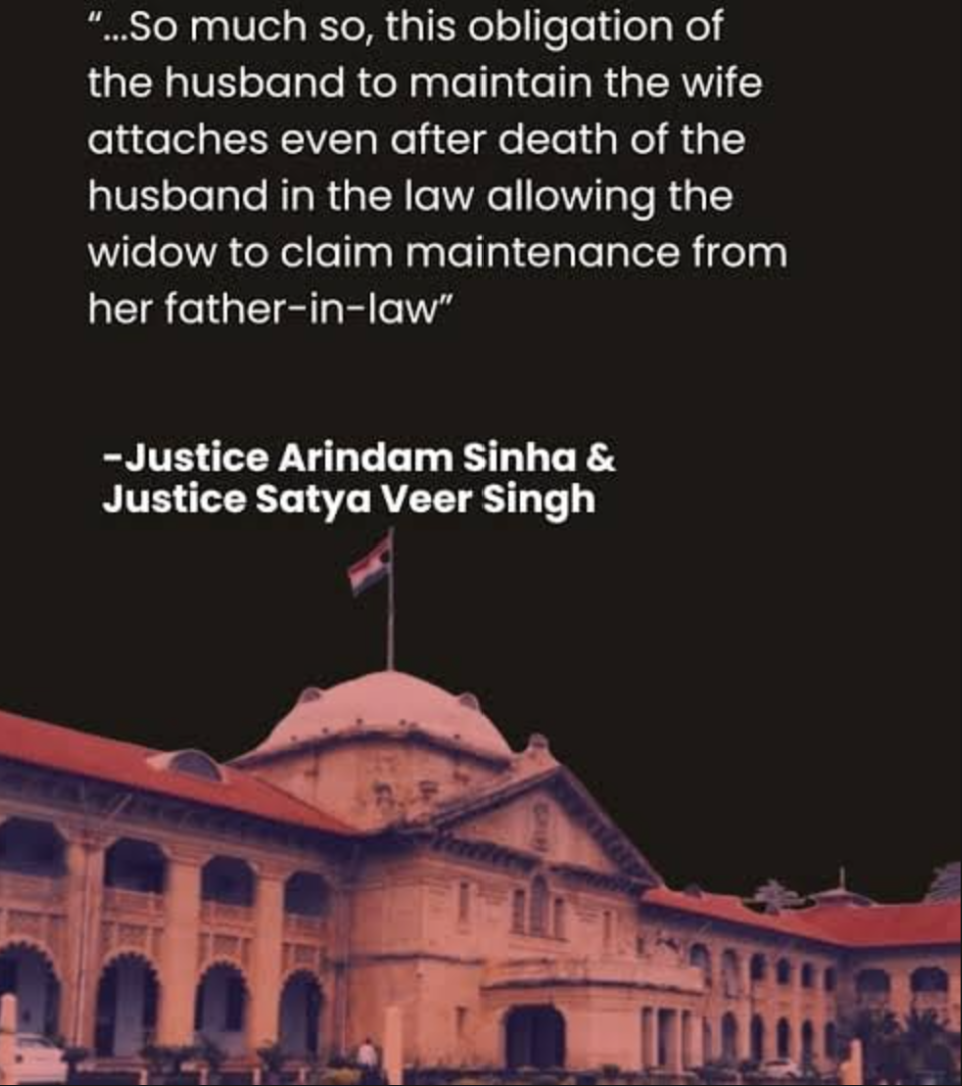
The Supreme Court recently issued a significant ruling that strengthens the rights of widows under Hindu family law. It was determined that a widow can claim maintenance not only from her deceased husband’s estate but also from his ancestral property, provided certain conditions are met.
In this case, a widow sought maintenance after her husband died intestate. The husband had been part of a joint Hindu family and had a share in the ancestral property. After his death, the widow was unable to support herself and requested maintenance from the property.
Opponents of her claim argued that since the property was part of a joint family, she could not seek maintenance from it. The case was brought before the Supreme Court to clarify this issue.
The Supreme Court in Kanchana Rai v. Geeta Sharma & Ors.[11] (2026) held that a daughter-in-law who becomes a widow even after the death of her father-in-law is a “dependant” under Section 21(vii) of the Hindu Adoptions and Maintenance Act, 1956. The Court ruled that the words “any widow of his son” are clear and do not depend on the timing of widowhood. It applied literal interpretation and refused to add the word “predeceased” to the statute. Denial of maintenance on such a technical ground would be arbitrary and violative of Articles 14 and 21 of the Constitution. Therefore, the widow is entitled to claim maintenance from the estate of her deceased father-in-law under Section 22 of the Act.
The ruling emphasised that maintenance is a continuing obligation under Hindu law and should promote social justice and protect vulnerable women. By allowing widows to claim maintenance from ancestral property, the Court prevents a narrow interpretation of the law that could leave them destitute. This decision affirms that maintenance is a legal right derived from the marital relationship and aligns with constitutional principles of equality and dignity.
Conclusion
This Supreme Court decision reinforces the evolving understanding of women’s rights within Hindu family law. While the traditional joint Hindu family system placed women in a dependent position, contemporary judicial interpretation ensures that widows are not left without financial support merely due to technical classifications of property.
The judgment serves as a crucial reminder that family law must be interpreted with a humane and purposive approach, especially when dealing with the rights of widows and other vulnerable family members. It strengthens the protective framework envisaged under the Hindu Adoptions and Maintenance Act, 1956, and ensures meaningful access to maintenance as a matter of right.
Despite progressive judicial interpretation, practical enforcement of women’s property and maintenance rights remains challenging due to social resistance, lack of awareness, and prolonged litigation.
Written by-
Name: Shraddha Bankey
NFSU, Gandhinagar, Gujarat
Email: gurjarshraddha16@gmail.com
[1] Poonam Pradhan Saxena, Family Law
[2] The Hindu Succession Act, No. 30 of 1956, INDIA CODE (1956).
[3] The Hindu Succession Act, No. 30 of 1956, § 6, INDIA CODE (1956).
[4] The Hindu Succession Act, No. 30 of 1956, § 14, INDIA CODE (1956).
[5] Kallakuri Pattabhiramaswamy (Dead) Through Lrs. v. Kallakuri Kamaraju & Ors., Civil Appeal No. 5389 of 2012, Supreme Court of India, 2024 INSC 883
[6] The Hindu Succession Act, No. 30 of 1956, § 30, INDIA CODE (1956).
[7] The Hindu Succession Act, No. 30 of 1956, § 8-13, INDIA CODE (1956).
[8] The Hindu Succession Act, (supra) at Pg 2.
[9] Vineeta Sharma v. Rakesh Sharma, (2020) 2020 INSC 487
[10] 2018 INSC 84 Danamma vs. Amar and Ors. (01.02.2018 – SC): MANU/SC/0064/
[11] Kanchana Rai v. Geeta Sharma & Ors., Civil Appeal Nos. 245–247 of 2026, Supreme Court of India, MANU/SC/0059/2026.
Need Legal Assistance?
If you need help with legal matters, our experienced team can guide you through the process and protect your rights.
Contact Us