

When a Breakup Ends in Tragedy: The Supreme Court on Abetment of Suicide
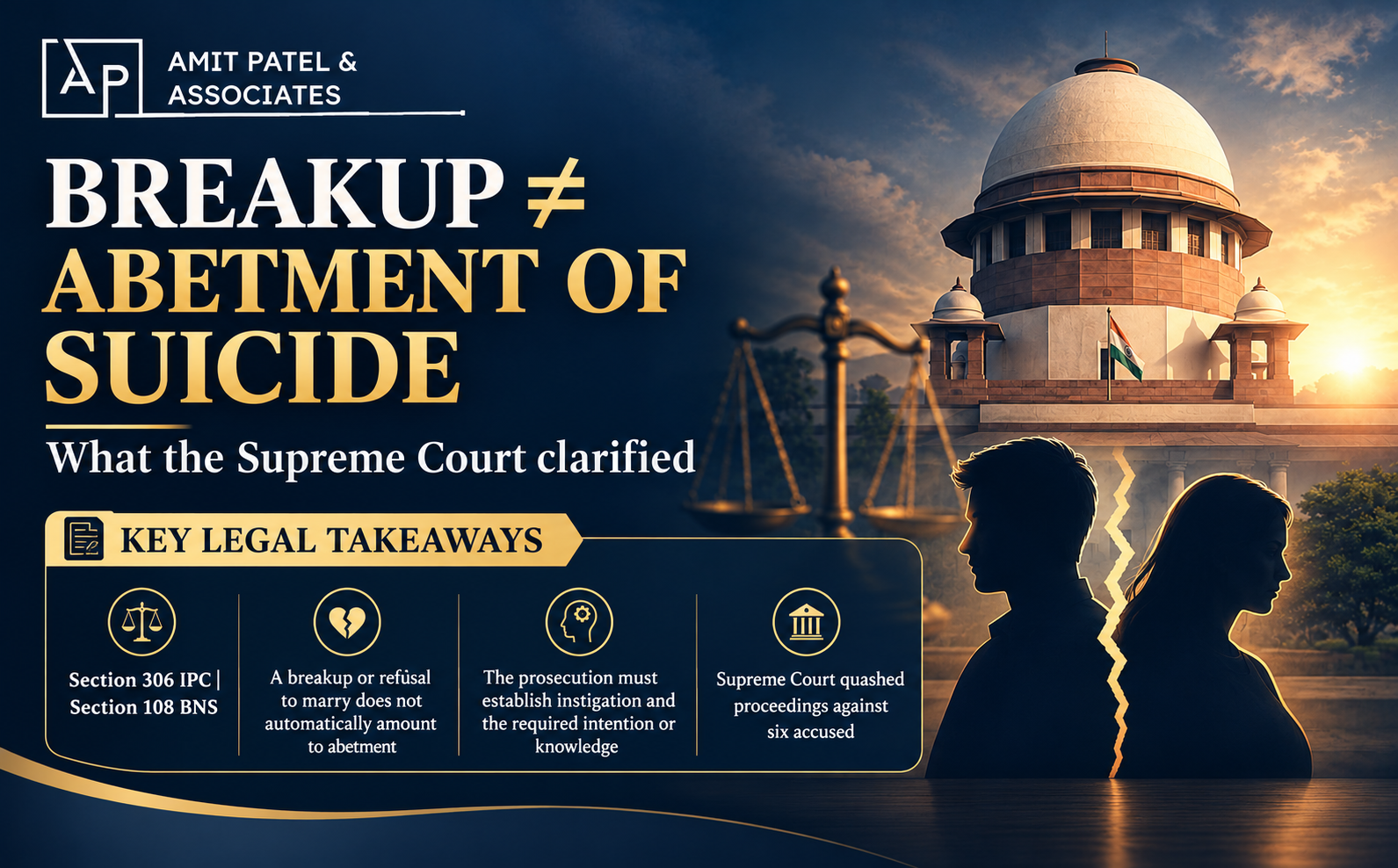
When a Breakup Ends in Tragedy: The Supreme Court on Abetment of Suicide
Chittibarika Chandra Shekar & Ors. v. State of Telangana, Supreme Court of India, decided October 5, 2026
A breakup, or a refusal to marry, does not become abetment of suicide merely because the other partner later takes their own life. On October 5, 2026, a Supreme Court bench of Justices J.B. Pardiwala and K. Vinod Chandran quashed a Section 306 IPC prosecution against six people on exactly that reasoning. The ruling is a timely reminder of what the offence actually demands: instigation, backed by intention or knowledge, and not just a tragic outcome.
The facts: a consensual relationship and a refused marriage
The case arose from Telangana, where a young woman died by suicide. An FIR registered in 2022 named six accused under Section 306 read with Section 34 of the Indian Penal Code, which covers abetment of suicide with common intention. The accused included her partner, his parents, his sister and others.
According to the reports of the judgment, the woman and her partner had lived together for about three months at his residence, in a consensual relationship that his family had accepted. The prosecution alleged that other family members and a friend later objected to the relationship, and that the partner then refused to marry her. In the prosecution’s telling, those circumstances amounted to instigation that led to her death.
The trial court and the Telangana High Court, which refused to quash the case by its order of February 20, 2026, allowed the proceedings to continue. The accused then appealed to the Supreme Court.
The law: what Section 306 actually requires
Section 306 IPC punishes anyone who abets the commission of suicide with imprisonment of up to ten years and a fine. Under the new criminal code, the corresponding provision is Section 108 of the Bharatiya Nyaya Sanhita, 2023, and the definition of abetment now sits in Section 45 BNS. Because the FIR in this case dates from 2022, the Court dealt with the IPC provisions, but the reasoning carries over directly.
Abetment, in turn, has three recognised forms: instigating a person to do a thing, engaging in a conspiracy for its doing, or intentionally aiding it. For suicide cases, the first form is the one that matters most. Instigation means actively urging, provoking or goading someone toward the act. It requires a positive act on the part of the accused, and that act must be intended to push the person toward self-harm, or at least be done with knowledge that it is likely to do so.
Courts have repeated this for years. An earlier decision reported at (2009) 16 SCC 605 stressed that different individuals react differently to the same situation, because each person attaches a personal meaning to events. A more recent bench of Justices Vikram Nath and K.V. Viswanathan, dealing with a refusal to continue a relationship, observed that broken relationships and heartbreak are part of everyday life. The principle, then, is not new. What this judgment does is apply it squarely to the refusal-to-marry scenario, which prosecutors still routinely charge under Section 306.
Two practical tests follow from this body of law. The first is proximity: the alleged act of instigation must be close enough in time and substance to the suicide that it can fairly be called a cause, and not a remote event in a long, difficult story. The second is intention, or at least knowledge. Courts ask whether the accused meant to bring about the death, or knew that a particular act was virtually certain to do so. Speaking in anger, ending a relationship or voicing disapproval, without more, rarely meets either test.
The ruling: no instigation, no abetment
The Court allowed the appeal and quashed the proceedings against all six accused, setting aside the contrary orders of the High Court and the trial court. Its reasoning can be broken into four steps.
- The suicide and the relationship were not in dispute. The Court noted that the death by suicide was established and that the informant herself admitted the relationship was consensual.
- Taking the prosecution’s case at its highest, the allegations disclosed only a refusal to marry followed by suicide. In the Court’s words, at worst that is what the informant’s own version showed.
- Abetment needs a mental element. The Court held that the refusal to marry was not made with an intention to drive the woman to suicide, and that the accused could not be attributed knowledge that she would take her life on such a refusal.
- Family members or friends who merely express disapproval of a relationship, or speak ill of a person, do not by that alone instigate suicide so as to attract Section 306 read with Section 34.
The central observation is worth remembering because of how plainly it is put: people react differently to situations, and a breakup ending in suicide cannot always be termed an abetment to suicide. The word “always” matters. The Court did not say that a breakup can never be abetment. It said that the outcome alone cannot supply the offence.
Why this is the right approach
Criminal law punishes culpable conduct, not sorrow. When a person dies by suicide, the people around them are often left with guilt, anger and a need for an explanation. Families understandably look for someone to hold responsible. But the criminal law cannot work backwards from a death to a crime. If it did, every ended relationship, every strained conversation and every harsh word would carry the risk of a prison term of up to ten years, depending entirely on how the other person later chose to respond.
There is also a point about autonomy. Ending a relationship, or declining to marry, is lawful conduct. Adults are entitled to make those decisions, and the law cannot sensibly treat the exercise of that freedom as an offence the moment the other party reacts with despair. A rule that did so would effectively compel people to remain in, or commit to, relationships against their will for fear of prosecution.
Finally, the ruling protects the wider circle of accused. In many abetment cases, the FIR names not just the partner but his parents, siblings and friends, often on the strength of generalised allegations. This case is a good example: six people faced trial although the allegations against most of them amounted to no more than disapproval. Insisting on a specific, intentional act of instigation keeps those prosecutions from becoming a way of casting a wide net over a household.
There is a further reason for caution that judges and lawyers alike should keep in mind: hindsight. Once a death has occurred, every earlier conversation is re-read in its darkest light, and ordinary quarrels start to look like warnings. The Court’s insistence on intention and knowledge guards against that distortion by asking what the accused understood and meant at the time, not what the tragedy later makes of their words.
Reports of the judgment also note that the woman had told a family member of her intention to end her life, and that no steps were taken to avert it. That detail is a painful reminder that suicide prevention is a shared human responsibility. It is not, however, a basis for criminal liability on its own, and the Court rightly kept moral failure and criminal guilt apart.
Practical takeaways for lawyers
For defence counsel, the judgment strengthens the case for seeking early termination of proceedings where the allegations, even if accepted in full, do not disclose instigation. The useful exercise is to read the FIR and the statements with one question in mind: what exactly did each accused say or do, when, and how was it meant to push the deceased toward suicide? Where the answer is only a refusal, a disagreement or a family objection, the Court’s reasoning applies directly. It is also a strong authority for arguing that relatives and friends at the periphery of the story should not face trial at all.
For prosecutors and complainants, the lesson runs the other way. A case under Section 306 or Section 108 BNS needs material beyond the fact of a breakup. Investigators should look for the things that actually show instigation: messages, calls and recorded conversations, ultimatums, threats, repeated humiliation, persistent harassment, or taunts that urge the person to end their life. A charge sheet that rests on the relationship ending and the death following is vulnerable, and after this judgment it is likely to be quashed.
For lawyers advising families who have lost a relative, there is a sensitive conversation to be had. The grief is real, and the Court itself did not minimise it. But clients should be told early that the law demands more than causation in the everyday sense, and that a complaint should set out specific acts and words rather than general accusations.
Finally, practitioners should keep in mind that the same reasoning will govern Section 108 BNS. For offences committed after July 1, 2024, the ingredients are the same, and this decision will be cited on both.
The limits of the ruling
It would be a mistake to read the judgment as a licence. The Court quashed these proceedings because, on the allegations as they stood, nothing amounted to instigation. Had the material shown threats, sustained harassment, humiliation or deliberate goading, the analysis could have gone the other way. The decision turns on the absence of intention or knowledge on the facts, and not on a rule that relationship breakdowns are immune from scrutiny.
Nor does it decide questions that arise under other provisions. A refusal to marry after a promise to marry made with no intention of keeping it raises different issues under other offences. Cases involving married women, where statutory presumptions and offences relating to cruelty come into play, also stand on a different footing. Counsel should read the full judgment carefully before relying on it in those settings. Reports of the judgment are secondary sources, and the precise language of the order should be checked against the certified text.
Closing thought
The judgment draws a line that the criminal law needs to keep drawing: tragedy is not the same as a crime. A person’s death by suicide is a profound loss, and it is natural to ask who failed them. But the law asks a narrower question, namely whether someone intentionally pushed them toward it. By insisting on that distinction, the Supreme Court has protected people from being prosecuted for ordinary, lawful decisions about their relationships, while leaving the door open for cases where real instigation can be shown.
Sources
- LiveLaw: If Breakup Ends Up With Suicide, It Cannot Always Be Termed Abetment To Suicide
- Law Chakra: Supreme Court Quashes Case: Breakup Ending In Suicide Cannot Always Be Termed Abetment
- Drishti Judiciary: Breakup Ending in Suicide Not Always Abetment
- Prime Legal: Can a Breakup Be Called Abetment of Suicide?
- Free Press Journal: Breakup, Refusal To Marry Do Not Automatically Amount To Abetment Of Suicide
- SCC Online Blog: Can breaking up and advising a partner to marry someone else amount to abetment to suicide?
Need Legal Assistance?
If you need help with legal matters, our experienced team can guide you through the process and protect your rights.
Contact Us