

THE COLONIAL TINGE OR THE THREAT TO DEMOCRACY: ANALYZING THE POTENTIAL MISUSE OF CRIMINAL CONSPIRACY
ABSTRACT
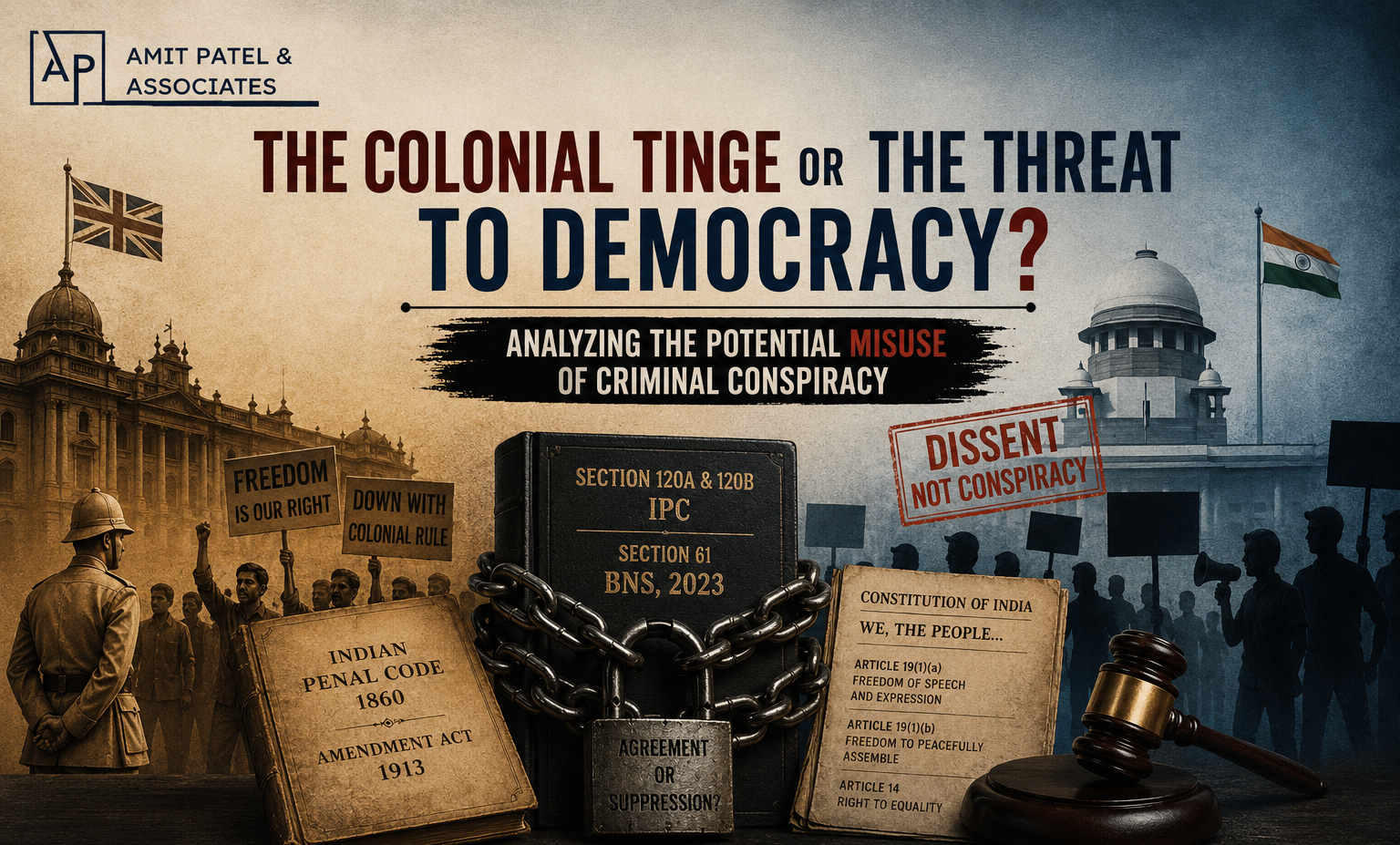
This blog analyses the offence of criminal conspiracy and how it has preserved a tinge of colonial rule. It has tried to analyze the ways in which it can serve as a potential misuse to democracy and concludes with arguing that it should have been removed from the Bharatiya Nyaya Sanhita.
INTRODUCTION
The offence of criminal conspiracy was not present inherently in the Indian Penal Code at the time of its formulation in 1860. It was introduced by the Amendment Act of 1913, where a separate chapter VA for criminal conspiracy consisting of sections 120A and 120B was introduced. It is also subsequently reflected under Section 61 of the Bharatiya Nyaya Sanhita, 2023. The main aim for the introduction of the act as an offence during the colonial period was to punish the agreements made between the freedom fighters to commit various acts for the freedom of the country like bombing the buildings of the British offices, stealing weapons or other acts considered as offences at that time. This provision aimed to punish these offences at the agreement stage itself and not wait till the attempt or commission of the offence. But this is exactly where the controversy lies now. The first case was registered in 1891 when the editor of a newspaper “Bangobasi” was tried for publishing his criticism of the “Age of Consent Bill”. But then it took a major turn with the trial of Bal Gangadhar Tilak in 1897, where Tilak’s speeches were alleged to have caused the murder of two British officers in Pune. In this trial, Justice James Strachey expanded or changed the interpretation of criminal conspiracy by equating “disaffection” with “disloyalty”. But now the question lies that since this act was introduced merely to punish the agreements for doing radical acts to gain freedom, does it act still hold that significance? Further, there are even chances that this provision is misused by the government to suppress public opinion in the name of criminal conspiracy. This can be seen through the further discussions of the blog.
WHAT IS CRIMINAL CONSPIRACY?
Conspiracy refers to the act of agreement by two or more people to cause to do, or be done, an offence or do any act in furtherance of the agreement in case, such agreement is for doing an action prohibited by law or an action which furnishes ground for civil suits, for example, committing nuisance or trespass. It is defined under Section 120A of the Indian Penal Code. Even when there is a case for committing an act which is fully legal but using illegal means, and there is an act of preparation for it or the act is committed, it falls within the ambit of criminal conspiracy. Thus, in case of any offence mentioned under the Indian Penal Code, mere agreement to do it can amount to criminal conspiracy.
In India, criminal conspiracy is punished under Section 120B. In cases where the criminal conspiracy is committed for offences punishable with death, imprisonment for life, or 2 years or more of imprisonment, it is punished in the same way as if he has abetted such an offence. But in all other cases of criminal conspiracy, that is, in case of offences punishable with less than two years, prohibited by law or actions which are civil wrongs, it is punished with imprisonment for a maximum of six months, or fine, or both.[1]
LANDMARK CASES
Emperor v. Barkat Ali and Anr.
This was one of the earliest cases of criminal conspiracy. Barkat Ali and Hamid Ali were held liable for violation of Section 25 of the Forests Act, as they, along with two others went to a reserved forest where the two of them shot a deer. They had formed a party and then went to the reserved forest with the object of hunting in a reserved forest, which is illegal, so they were held liable for criminal conspiracy since they had mutually agreed to a common cause, and acted towards the same.[2]
Topandas v. State of Bombay
In this case, the accused along with all the co-accused agreed to commit certain illegal acts. Firstly, they forged bills of entry, then heated the deputy controller by fraudulently inducing him to deliver some cycles from the UK, and further cheated the Deputy Chief Controller of Imports into importing watches from Switzerland. All the acts were done in pursuance of the agreement. They were, thus, held liable for criminal conspiracy under Section 120B read with 471 and 464 read with 34.[3]
Ram Narain Popli v. Central Bureau of Investigation
The five accused were tried for the offences of cheating, criminal breach of trust, forgery by using forged documents, dishonest misappropriation of public funds and criminal conspiracy under Section 120B read with Sections 420, 409, 467 and 471 of the Indian Penal Code. The court, in this case, held that the Central Bureau of Investigation has the power to investigate cases of criminal conspiracy. Further, the court also held that the essence of criminal conspiracy lies in the agreement, and therefore, the prosecution has to prove that the accused had an agreement or plan to commit the offence.[4]
WAYS IN WHICH IT CAN LEAD TO AN AUTHORITARIAN RULE AND OVERTHROW DEMOCRACY
There are many offences which can be misused by the leading government and, hence, lead to an authoritarian rule like that of the colonial rule by suppressing the freedom of speech and expression: –
- Unlawful assembly
The Constitution of India guarantees the right to assemble peacefully and without arms, but unlawful assembly, which is explained as an assembly of five or more people which is likely to cause a breach of public peace and order.[5] The term ‘likely to cause’ is in itself subjective and hence, given a plethora of interpretations. In cases of unlawful assembly, the people assembled must have a common intention of committing an offence.
Sometimes, in cases of peaceful and non-violent protests also, the government uses this provision under Section 144 of the Criminal Procedural Code, to curb the voice of the citizens by pointing the processions as an unlawful assembly, while they are merely making the public aware of their rights by raising voice against their violation through a procession. Thereby, the agreement to conduct such a procession, tagged as unlawful assembly, is even punished under criminal conspiracy under the mere presumption that it might disrupt the peace and order of the society.[6]
- Sedition
The Constitution of India, under the ambit of fundamental rights, also includes the right to freedom of free speech and expression under Article 19(1)(a),[7] but this right can be curbed under reasonable restrictions. One such restriction is that the speech should not be seditious in nature, that is, it should not have the effect of spreading disaffection towards the government or inciting or making the audience violent. If it does so, such act is punished under the offence of sedition, which as per Section 124A of the Indian Penal Code is punishable with three years or more, or fine, or both.[8]
Now, this provision can be easily misused by the government by tagging any kind of positive criticism against the government or awareness speeches also as “seditious” speeches, and hence, even agreement to make seemingly “seditious” speeches in public as per the view of the government can be termed as criminal conspiracy under Section 120A, if proved with proper evidence, and then punished as per Section 120B.[9]
- Wage war, or attempt to wage war, or abetment to wage war
Waging war, or attempting to wage war, or abetting to wage war, is considered one of the most grave offences in the country as it threatens the sovereignty and security of the country. Therefore, agreements to do this offence are treated very seriously, but this can be misused by the ruling government as well to punish the people of opposite parties by curating false evidence, or by interpreting an agreement differently to make it sound more serious.[10]
- Misuse by the investigating officers
Due to procedural failures, the investigating officers often enter the names of all the people who seem doubtful in the charge sheet, charging them for criminal conspiracy under Section 120B, sometimes, even without proper investigation and evidence. This causes the harassment of even those who were not involved. Further, once their name comes in the charge sheet, the burden of proof falls on them to prove they were not a part of the conspiracy, which becomes very difficult for the defence side to prove.
REASONS FOR WHICH IT SHOULD HAVE BEEN REMOVED FROM BHARATIYA NYAYA SANHITA
The main argument given for the introduction of the Bharatiya Nyaya Sanhita as a replacement for the Indian Penal Code was that it was introduced by the Britishers during the colonial rule and, therefore, had a colonial tinge to it, which the current government wanted to remove. Therefore, this provision in itself should have been removed as a whole or should have been amended to the Indian condition. The main reason for that is that this is the greatest evidence of colonial tinge existing in the Indian Penal Code since this, in itself, was introduced to nip the great independence movement of our freedom fighters as a whole and can be further misused by the current government to curb the right to freedom of speech and expression of the citizens of the country, therefore, transforming the democratic rule of India into an authoritarian rule.
Further, if there are punishments for attempts to various types of crimes, I, as a law student, do not find relevance in punishing mere agreements, after which not a single act of preparation was even committed, and that too, punishing the act of agreement as seriously as abetment of the offence.
CONCLUSION
The concept of criminal conspiracy in India sparks a crucial debate, or at least, has the potential to do so. While it aims to deter harmful acts, its potential for misuse under the current framework raises concerns about stifling dissent and democratic processes. This blog has highlighted the historical context, legal definition, and potential pitfalls of this provision. However further discussion and analysis are still needed to determine whether reforming or removing the current criminal conspiracy law is essential to ensure a fair and just legal system that upholds the fundamental rights of all Indian citizens.
[1] The Indian Penal Code, 1860, § 120B, Acts of Parliament, 1860 (India).
[2] Emperor v. Barkat Ali and Anr. (1918) ILR 40ALL38.
[3] Topandas v. State of Bombay (1955) AIR 1956 SC 33
[4] Raj Narain Popli v. Central Bureau of Investigation (2003) AIR 2003 SC 2748.
[5] INDIA CONST. art. 19, cl. b.
[6] The Code of Criminal Procedure, 1973, § 120B, Acts of Parliament, 1860 (India).
[7] INDIA CONST. art. 19, cl. a.
[8] The Indian Penal Code, 1860, § 124A, Acts of Parliament, 1860 (India).
[9] The Indian Penal Code, 1860, § 120B, Acts of Parliament, 1860 (India).
[10] The Indian Penal Code, 1860, § 121, Acts of Parliament, 1860 (India).
By Anwesha Nayak, final-year student at the Institute of Law, Nirma University.
Need Legal Assistance?
If you need help with legal matters, our experienced team can guide you through the process and protect your rights.
Contact Us