

State Surveillance, Mass Facial Recognition, and Constitutional Privacy Rights in India
Introduction
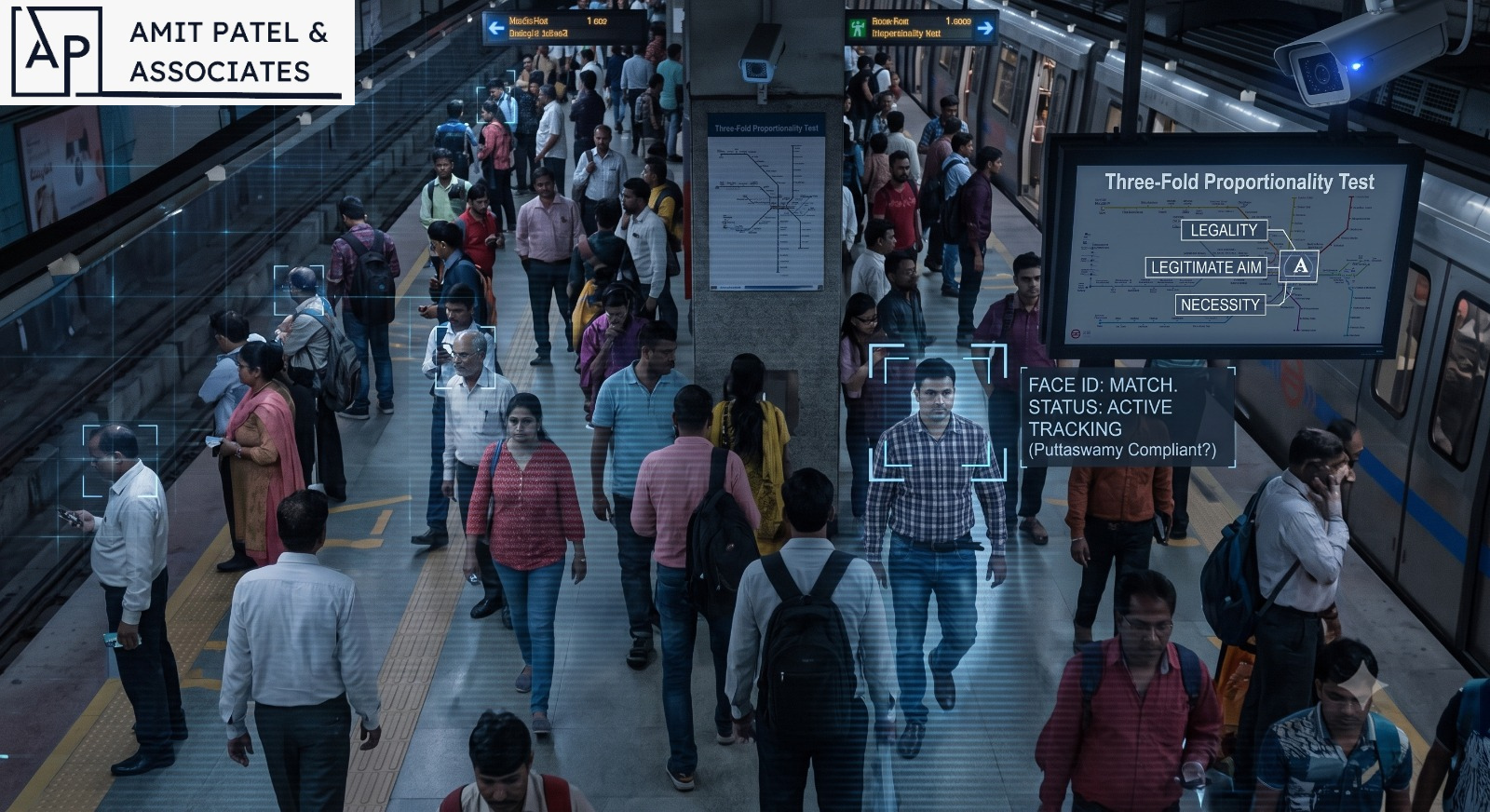
Think about the things you have on your phone now. You have your conversation with your doctor, your banking app that knows how much money you make, photos you do not want anyone else to see, and your location is tracked every hour of every day. For most of us our smartphones are like a part of us a record of who we’re. Along with interception and spyware modern surveillance has gone into public spaces through Mass Facial Recognition Technology, which allows the government to track people automatically in public places.
When the government can look into your life or map your face in public without your permission it is not just collecting data it is watching your life. Finding a balance between the governments need for security and individual privacy has become a big challenge. This paper looks at state surveillance and mass tracking through the lens of Article 21 of the Indian Constitution testing these measures against the standards set in the Justice K.S. Puttaswamy case.
Legal Framework
The governments interception and public tracking are not happening in a vacuum they are based on old laws, new laws and administrative rules.
The Indian Telegraph Act, 1885
The Indian Telegraph Act 1885 gives the Central or State Government the power to intercept messages in case of an emergency or for public safety. The reasons for this include the sovereignty and integrity of India, state security, friendly relations with countries, public order or preventing a crime. The language used in this law is now being used to govern digital spyware and electronic tracking.
Rule 419A of the Indian Telegraph Rules, 1951
To prevent misuse Rule 419A says that interception orders must be authorized by ranking officials, like the Union Home Secretary or State Home Secretaries. It also outlines how to keep records review by a committee and destroy data after a certain period.
The Information Technology Act, 2000 and Interception Rules
Digital communications are regulated under the Information Technology Act, 2000 which allows the state to decrypt and monitor data. However these provisions are often criticized for being vague especially when it comes to cybersecurity, which gives the government a lot of power.
Lack of Regulation for Mass Facial Recognition Tracking
Unlike telecommunications interception Mass Facial Recognition Technology in India does not have a law passed by Parliament. It is based on guidelines, police manuals or administrative tenders which raises questions about the governments authority.
Judicial Analysis
Justice K.S. Puttaswamy (Retd.) v. Union of India
The Justice K.S. Puttaswamy case declared the right to privacy as a right under Article 21 of the Constitution of India. The Supreme Court said that any intrusion by the state must satisfy three tests:
The action must be based on a law.
The action must have a public purpose, like national security.
The action must be proportional to the goal using the restrictive means.
Proportionality Analysis
While the Puttaswamy case established a threefold test Indian courts often use a four-pronged doctrine of proportionality to assess fundamental rights infringements:
The measure must be authorized by law.
The measure must serve a state goal.
There must be a connection between the measure and the goal and the measure must be the least restrictive means available.
The impact on rights must not be disproportionate to the benefit achieved.
Manohar Lal Sharma v. Union of India
In the Manohar Lal Sharma case the Supreme Court said that the state cannot just use security as an excuse to do whatever it wants. The Court appointed a committee to look into allegations of spyware deployment emphasizing the need for judicial oversight.
Critical Evaluation
Looking at Indias surveillance and tracking system there are gaps when compared to constitutional standards:
Lack of Independent Oversight
The review mechanism is entirely controlled by the branch, which can lead to arbitrary power.
Mass Facial Recognition vs. Targeted Tracking
Targeted interception requires suspicion and formal authorization but Mass Facial Recognition Technology captures biometric identifiers from public spaces without any suspicion failing the necessity and proportionality tests.
Impact on Freedom of Speech
surveillance and public tracking can harm democratic participation by creating a chilling effect, where people self-censor because they know their movements and communications are being captured, undermining the freedom of speech and expression.
Challenges and Counterarguments
While privacy advocates emphasize autonomy the state argues that national security and administrative necessity are crucial:
National Security and Counter-Terrorism
The state says that contemporary security threats require access to metadata, device intelligence and automated tracking to prevent threats.
Operational Efficiency in Public Order and Law Enforcement
Mass Facial Recognition Technology is seen as essential for managing order locating missing persons and identifying habitual offenders enhancing efficiency in law enforcement.
Balancing Security and Constitutional Limits
The challenge is to prevent the states interest in security from overriding safeguards requiring narrow statutory definitions strict judicial warrant requirements and clear sunset clauses for stored biometric and interception data.
Bibliography
Primary Sources
- The Constitution of India 1950.
- The Indian Telegraph Act, 1885.
- The Information Technology Act, 2000.
- The Indian Telegraph Rules, 1951.
- The Information Technology (Procedure and Safeguards for Interception, Monitoring and Decryption of Information) Rules, 2009.
Case Law
- Justice K.S. Puttaswamy (Retd.) v. Union of India (2017) 10 SCC 1.
- Manohar Lal Sharma v. Union of India (2021) 8 SCC 493.
- Peoples Union for Civil Liberties (PUCL) v. Union of India (1997) 1 SCC 301.
Reports & Secondary Literature
- Law Commission of India Report No. 200: Trial by Media, 2006.
- Centre for Internet and Society Surveillance Jurisprudence, in India, 2020.
- Chuma Himonga et al., Digital Rights and Constitutional Standards, Oxford University Press, 2021.
Need Legal Assistance?
If you need help with legal matters, our experienced team can guide you through the process and protect your rights.
Contact Us