

GEOENGINEERING AND SOLAR RADIATION MANAGEMENT: LEGAL AND ETHICAL CONSIDERATIONS
GEOENGINEERING AND SOLAR RADIATION MANAGEMENT: LEGAL AND ETHICAL CONSIDERATIONS
By Anushka Sharma
B.B.A. LL.B. (Hons.) Semester VIII, GLS University.
Who controls the sun?
The question may sound philosophical, yet it lies at the heart of one of the most controversial ideas emerging in modern climate science. As global temperatures continue to rise and the effects of climate change intensify, scientists and policymakers are increasingly exploring technological interventions that could directly influence the Earth’s climate system. One such proposal involves reflecting a portion of sunlight away from the planet in order to reduce global temperatures. Known as solar radiation management, this approach forms part of a broader concept called geoengineering large-scale technological interventions designed to deliberately alter the Earth’s climate.
The idea of intentionally modifying the climate once belonged primarily to science fiction. Today, however, it has become part of serious scientific and policy discussions. While geoengineering technologies may offer potential tools to temporarily slow global warming, they also raise complex legal, ethical, and governance challenges. Existing international climate frameworks were designed primarily to reduce greenhouse gas emissions, not to regulate technologies capable of manipulating the planet’s climate system.
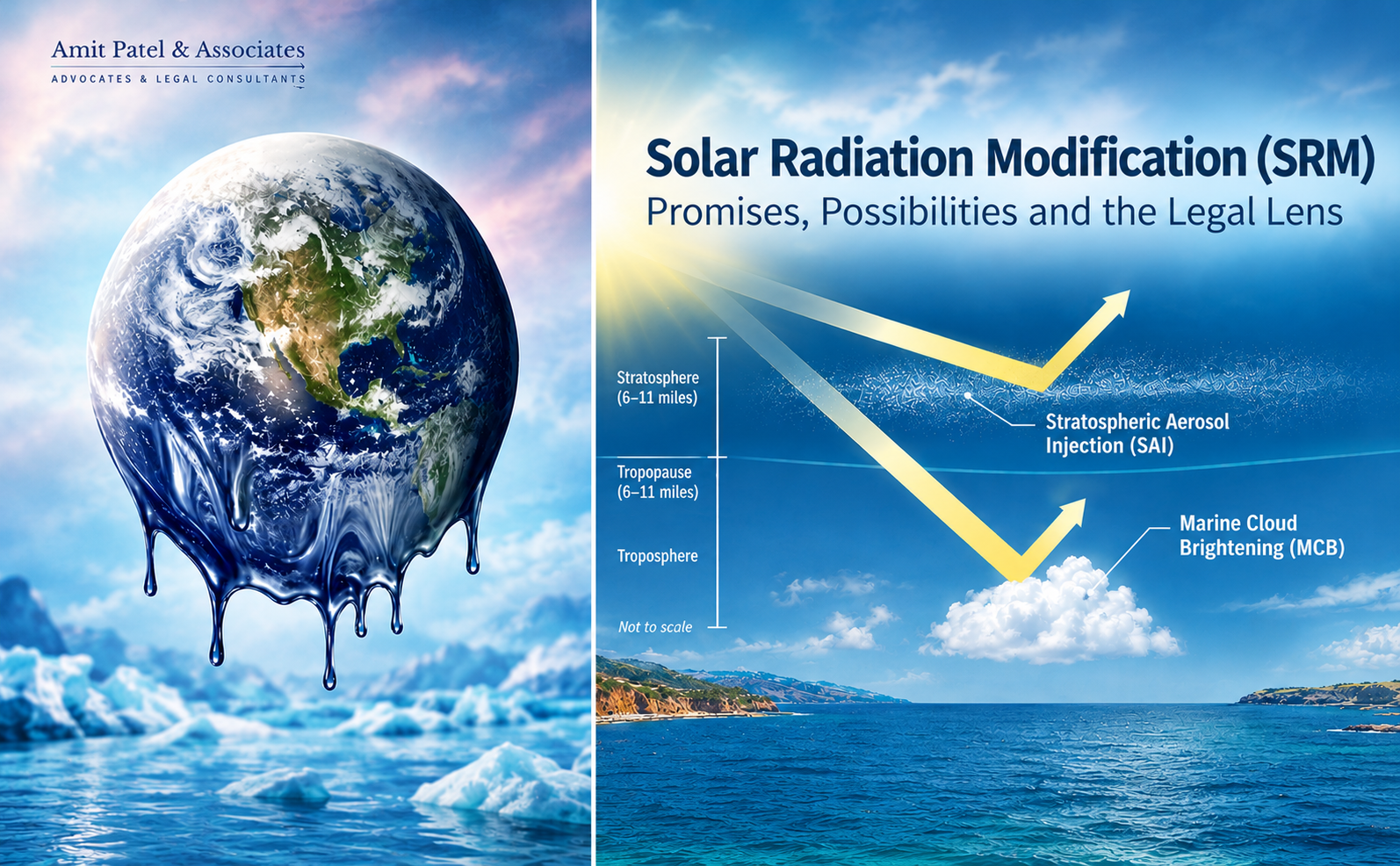
Geoengineering refers to large-scale technological efforts aimed at deliberately influencing the Earth’s climate system in order to counter rising global temperatures. Scientists often classify these interventions into two broad categories. The first involves removing carbon dioxide from the atmosphere, while the second seeks to reduce the amount of solar radiation absorbed by the Earth. Solar radiation management (SRM) falls into the latter category and aims to increase the planet’s reflectivity so that a small portion of incoming sunlight is reflected back into space.
One of the most widely discussed SRM techniques is stratospheric aerosol injection, which would involve releasing tiny reflective particles into the upper atmosphere. This concept draws inspiration from natural volcanic eruptions, which sometimes produce temporary cooling effects by dispersing similar particles that scatter sunlight. Other proposed methods include marine cloud brightening, which seeks to increase the reflectivity of clouds over oceans, and even more speculative ideas such as space-based reflectors that could deflect sunlight before it reaches the Earth’s surface. Although most of these technologies remain experimental, scientific research on geoengineering has expanded rapidly in recent years.
Source: U.S. Environmental Protection Agency, “About Geoengineering.”
Reports by the Intergovernmental Panel on Climate Change have acknowledged that geoengineering methods may influence global temperatures, while simultaneously warning about their significant uncertainties and risks. Importantly, solar radiation management does not remove greenhouse gases from the atmosphere. Instead, it merely reduces the warming effect by reflecting sunlight, meaning that it cannot replace long-term climate mitigation strategies aimed at reducing emissions.
Despite growing scientific interest, there is currently no comprehensive international legal framework specifically regulating geoengineering technologies. Global climate agreements such as the United Nations Framework Convention on Climate Change and the Paris Agreement focus primarily on reducing greenhouse gas emissions, strengthening climate resilience, and supporting international cooperation. These agreements contain limited guidance on how technologies designed to deliberately modify the Earth’s climate should be governed.
This lack of regulation creates a significant governance gap. Climate systems operate on a global scale, meaning that actions taken in one region may have consequences elsewhere. If a country were to deploy solar radiation management technologies independently, the resulting atmospheric changes could potentially alter rainfall patterns, agricultural productivity, or weather systems in other parts of the world. Such scenarios raise important questions regarding international responsibility and liability.
Several environmental law organizations have also cautioned against the premature deployment of geoengineering technologies. The Center for International Environmental Law has warned that large-scale climate interventions could create serious environmental and human rights risks because their impacts would extend beyond national borders and potentially affect millions of people. The organization further argues that geoengineering proposals risk promoting the illusion of a technological “quick fix” to climate change, thereby weakening global commitments to emissions reduction and sustainable development. These concerns highlight the urgent need for transparent international governance before any geoengineering technologies are deployed at scale.
Certain principles of international environmental law may provide partial guidance. The no-harm principle, for instance, requires states to ensure that activities within their jurisdiction do not cause environmental damage beyond their borders. Similarly, the precautionary principle encourages policymakers to act cautiously when scientific uncertainty surrounds potentially harmful activities. However, these principles alone may not provide adequate regulatory mechanisms for technologies capable of altering the global climate system.
A less discussed but equally important issue concerns the growing role of private actors in developing geoengineering technologies. Universities, research institutions, and technology companies have increasingly begun exploring climate intervention methods. Some components of these technologies may be protected by patents or other forms of intellectual property rights. If climate intervention technologies become subject to exclusive ownership or restrictive licensing practices, access to them could become concentrated among a limited number of powerful actors. This raises broader concerns about technological control, global equity, and whether technologies capable of affecting the entire planet should remain privately controlled.
Beyond legal concerns, geoengineering also raises significant ethical questions.One widely discussed issue is the risk of moral hazard. If governments believe that technological interventions could offset rising temperatures, they may reduce their efforts to cut greenhouse gas emissions. This could delay the transition to renewable energy systems and sustainable development policies, potentially worsening the long-term climate crisis.
In addition to moral hazard, geoengineering poses challenges for climate justice. Climate systems are extremely complex, and technological interventions designed to cool the planet may not produce uniform outcomes across regions. Changes in atmospheric circulation patterns could disrupt rainfall systems or agricultural cycles in certain parts of the world. Communities that are already vulnerable to climate change could therefore face additional risks if geoengineering interventions produce unintended consequences.
India’s position in global climate discussions provides an important perspective in this debate. As a developing country that is highly vulnerable to climate impacts, India has consistently emphasized the importance of equity and common but differentiated responsibilities in international climate governance. India’s climate policy has generally prioritized mitigation, adaptation, and sustainable development over experimental technological interventions. In international negotiations, India has also supported precautionary approaches toward geoengineering research, highlighting concerns about environmental risks and the potential for technological dominance by developed nations. Given India’s dependence on monsoon systems for agriculture and water security, any technology capable of altering atmospheric circulation patterns raises particular concerns.
At the same time, discussions surrounding climate technologies continue to evolve. While India actively participates in international climate innovation initiatives, it has also emphasized that technological solutions must remain consistent with principles of sustainability, transparency, and global equity.
As debates about solar radiation management continue, many experts argue that stronger international governance mechanisms are essential. Establishing global guidelines for geoengineering research, environmental risk assessment, and public transparency could help ensure that technological experimentation does not proceed without adequate oversight. International cooperation will also be critical in ensuring that innovations in climate technology benefit the global community rather than a limited number of powerful actors.
Geoengineering represents one of the most ambitious and controversial ideas proposed in the fight against climate change. The possibility of intentionally altering the Earth’s climate forces humanity to confront difficult questions about responsibility, governance, and technological power. Addressing climate change ultimately requires not only scientific innovation but also thoughtful legal and ethical frameworks that ensure such innovations are used responsibly and in the collective interest of the planet. In many ways, geoengineering represents a paradox of modern climate governance: humanity may possess the technological ability to alter the planet’s temperature before it develops the legal institutions capable of regulating such power. The debate surrounding solar radiation management therefore raises a fundamental governance question: should humanity possess the technological ability to alter the planet’s climate before developing the legal frameworks necessary to regulate it?
The future is closer than you think.
References :
- Paris Agreement, Dec. 12, 2015, T.I.A.S. No. 16-1104, https://unfccc.int/process-and-meetings/the-paris-agreement/the-paris-agreement.
- United Nations Framework Convention on Climate Change, May 9, 1992, 1771 U.N.T.S. 107, https://unfccc.int/resource/docs/convkp/conveng.pdf.
- Intergovernmental Panel on Climate Change, Climate Change 2023: Synthesis Report (2023), https://www.ipcc.ch/report/ar6/syr/.
- The Royal Society, Geoengineering the Climate: Science, Governance and Uncertainty (2009), https://royalsociety.org/topics-policy/publications/2009/geoengineering-climate/.
- National Research Council, Climate Intervention: Reflecting Sunlight to Cool Earth (Nat’l Acads. Press 2015), https://nap.nationalacademies.org/catalog/18988/climate-intervention-reflecting-sunlight-to-cool-earth.
- David W. Keith, A Case for Climate Engineering (MIT Press 2013).
- Janos Pasztor, Richard J. Black & Anna‑Maria Hubert, Solar Radiation Management: The Governance Challenge, 5 Global Challenges 2000145 (2021), https://onlinelibrary.wiley.com/doi/10.1002/gch2.202000145.
- World Intellectual Property Organization, WIPO Green Technology Book (2022), https://www.wipo.int/edocs/pubdocs/en/wipo_pub_1080.pdf.
- Center for International Environmental Law, Geoengineering, https://www.ciel.org/issue/geoengineering/ (last visited Mar. 10, 2026).
- United States Environmental Protection Agency, About Geoengineering, https://www.epa.gov/geoengineering/about-geoengineering (last visited Mar. 10, 2026).
Need Legal Assistance?
If you need help with legal matters, our experienced team can guide you through the process and protect your rights.
Contact Us