

CHEQUE BOUNCE CASES IN INDIA: BALANCING COMMERCIAL CREDIBILITY AND CRIMINAL LIABILITY UNDER SECTION 138 OF THE NEGOTIABLE INSTRUMENTS ACT, 1881
Introduction
Even with the rapid growth of digital payment methods, cheques continue to play an important role in transactions. They are widely used for business dealings, loan repayments, property transactions, and contractual payments. However, when a cheque is dishonoured, it causes financial loss to the payee. To maintain the reliability the legislature introduced Chapter XVII in the Negotiable Instruments Act, 1881 through the Banking, Public Financial Institutions and Negotiable Instruments Laws (Amendment) Act, 1988. Section 138 makes the dishonour of a cheque a criminal offence, provided all the legal requirements are fulfilled.[1] This blog examines the legal framework governing cheque dishonour in India, the essential ingredients of the offence, significant judicial pronouncements, the defences available to the accused, and the practical implications of these provisions for individuals and businesses.
What is a Cheque Bounce?
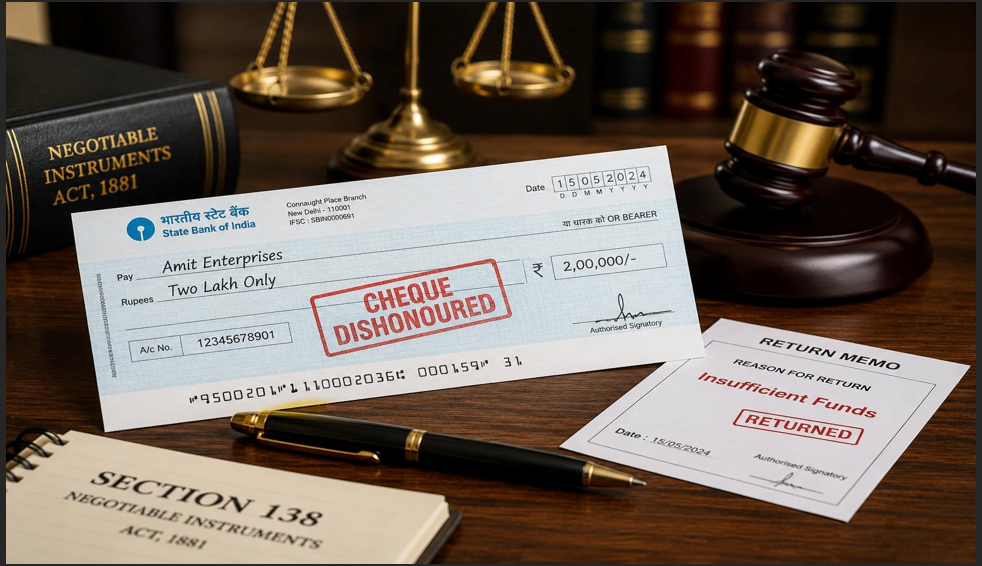
A cheque dishonour, happens when a bank refuses to make payment on a cheque presented for encashment. In such cases, bank returns the Cheque Return Memo stating the reason for the dishonour.[2] Although a cheque may be dishonoured for different technical or procedural reasons, criminal liability under Section 138 of the Negotiable Instruments Act, 1881 generally arises only when the cheque is returned because of insufficient funds or when the amount exceeds the arrangement made with the bank, provided all the legal requirements are fulfilled.[3]
For example, A, a supplier of construction materials, sells goods worth ₹2,00,000 to B, a contractor. To pay for the goods, B issues a cheque. When A deposits the cheque, the bank returns it unpaid because there are insufficient funds in B’s account. After receiving the statutory demand notice, B does not make the payment within the prescribed time. Then after, A can file criminal proceedings under this act.
Relevant Legal Provisions
The law relating to cheque bounce cases is mainly found in Chapter XVII of the Negotiable Instruments Act, 1881.
Section 6 defines a cheque as a bill of exchange drawn on a specified banker and payable on demand. After later amendments, the law also includes electronic cheques and truncated cheques within this definition.[4]
Section 138 makes cheque dishonour a criminal offence, provided all the legal conditions are fulfilled. A person found guilty under this section may be punished with imprisonment for up to two years, a fine of up to twice the cheque amount, or both.[5]
Section 139 creates a rebuttable presumption that the cheque was issued to discharge a legally enforceable debt or liability. As a result, the accused must produce evidence to rebut this legal presumption.[6] Section 140 further restricts the defences available to the drawer by not allowing them to argue that they had no reason to believe the cheque would be dishonoured when it was issued.[7]
If the cheque is issued by a company, Section 141 extends criminal liability to every person subject to the exceptions provided under the Act. Section 142 lays down the procedure for filing a complaint, including the limitation period and the court that has the authority to take cognisance of the offence.[8]
Sections 143 to 147 are intended to make the legal process faster and more effective. Recent amendments have also introduced provisions for interim compensation and payment during the pendency of appeals, with the aim of providing quicker relief to the complainant.[9]
Essential Ingredients of an Offence under Section 138
- 1. Existence of a Legally Enforceable Debt or Liability
The cheque must have been issued to repay, either fully or partly, a legally enforceable debt or liability. Gifts, donation and illegal purposes are exceptions.[10]
- 2. Issuance of the Cheque
Once the accused admits or the complainant proves that the cheque was signed and issued by the drawer, the presumption under Section 139 applies .[11]
- 3. Presentation of the Cheque Within Its Validity Period
The cheque must be presented to the bank by the payee or the holder in due course within its period of validity. [12]
- Dishonour of the Cheque
The bank’s return memo is an important document for proving that the cheque was dishonoured.[13]
- 5. Issuing a Statutory Demand Notice
After receiving dishonoured cheque, the payee must send a written notice within the prescribed time. [14]
- Failure to Make Payment Within Fifteen Days
If the payment is not made within this period, the complainant gets the right to file a criminal complaint before the competent court .[15]
Therefore, every dishonoured cheque does not amount to a criminal offence. Section 138 applies only when a cheque issued for a legally enforceable debt or liability is dishonoured and the drawer fails to make the payment even after being given the statutory opportunity to do so.
Landmark Judicial Pronouncements
In Rangappa v. Sri Mohan, the Supreme Court held that the presumption under Section 139 also includes the existence of a legally enforceable debt or liability. At the same time, the Court made it clear that this presumption is not absolute. The accused can rebut it by proving their defence on the basis of a preponderance of probabilities, rather than beyond a reasonable doubt.[16]
In Bir Singh v. Mukesh Kumar, the Court held that a signed blank cheque voluntarily handed over to another person does not become invalid merely because its details were filled in later.[17] This judgment prevents drawers from avoiding liability simply by claiming that the cheque was blank when signed.
The Supreme Court also addressed delays in cheque bounce cases in Indian Bank Association v. Union of India. The Court issued several directions to speed up the disposal of such cases.[18]
In Meters and Instruments (P) Ltd. v. Kanchan Mehta, the Court observed that the main purpose of Section 138 is to ensure that the complainant receives compensation rather than to send the accused to prison in every case.[19]
In Dashrath Rupsingh Rathod v. State of Maharashtra, where the Supreme Court initially ruled that a complaint under Section 138 could be filed only in the court having jurisdiction over the drawee bank.[20] Later Parliament passed the Negotiable Instruments (Amendment) Act, 2015, which restored jurisdiction mainly to the court where the payee’s bank is situated.[21] This amendment made it easier for complainants to pursue legal remedies.
Together, these judgments have shaped the law relating to cheque dishonour. They have strengthened the credibility of cheque transactions while ensuring that criminal proceedings are not used unfairly. They have also made the legal process more clear, practical, and consistent.
Conclusion
Cheque bounce cases continue to make up a large number of criminal cases pending before courts in India. Although Section 138 has improved the reliability of cheque transactions, delays in deciding these cases often reduce its effectiveness in helping complainants recover their money quickly. To address this issue, the legislature and the judiciary have introduced several reforms, such as summary trials, interim compensation, mediation, and compounding of offences, to encourage faster settlement of disputes. In the end, the real purpose of Section 138 is not only to punish offenders but also to promote financial discipline, encourage settlement of disputes, and maintain trust in commercial dealings.
References
Bare Acts
- Negotiable Instruments Act, 1881.
- Banking, Public Financial Institutions and Negotiable Instruments Laws (Amendment) Act, 1988.
Cases
- Bir Singh v. Mukesh Kumar, (2019) 4 SCC 197.
- C. Alavi Haji v. Palapetty Muhammed, (2007) 6 SCC 555.
- Dashrath Rupsingh Rathod v. State of Maharashtra, (2014) 9 SCC 129.
- Indian Bank Association v. Union of India, (2014) 5 SCC 590.
- Kusum Ingots & Alloys Ltd. v. Pennar Peterson Securities Ltd., (2000) 2 SCC 745.
- Meters and Instruments (P) Ltd. v. Kanchan Mehta, (2018) 1 SCC 560.
- Rangappa v. Sri Mohan, (2010) 11 SCC 441.
Reports and Secondary Sources
- Law Commission of India, 213th Report on Fast Track Magisterial Courts for Dishonoured Cheque Cases (2008).
[1] Negotiable Instruments Act, 1881, s. 138.
[2] Negotiable Instruments Act, 1881, ss. 91–92 (Dishonour by non-payment and noting of dishonour).
[3] Kulsum Ingots & Alloys Ltd. V. Pennar Peterson Securities Ltd., (2000) 2 SCC 745.
[4] Negotiable Instruments Act, 1881, s. 6.
[5] Negotiable Instruments Act, 1881, s. 138.
[6] Negotiable Instruments Act, 1881, s. 139; , (2010) 11 SCC 441.
[7] Negotiable Instruments Act, 1881, s. 140.
[8] Negotiable Instruments Act, 1881, ss. 141–142.
[9] Negotiable Instruments Act, 1881, ss. 143–148 (as amended by the Negotiable Instruments (Amendment) Act, 2018).
[10] Negotiable Instruments Act, 1881, Explanation to s. 138.
[11] Negotiable Instruments Act, 1881, s. 139; Bir Singh v. Mukesh Kumar, (2019) 4 SCC 197.
[12] Negotiable Instruments Act, 1881, proviso (a) to s. 138.
[13] Negotiable Instruments Act, 1881, s. 146.
[14] Negotiable Instruments Act, 1881, proviso (b) to s. 138; C.C. Alavi Haji v. Palapetty Muhammed, (2007) 6 SCC 555.
[15] Negotiable Instruments Act, 1881, proviso © to s. 138; s. 142.
[16] Rangappa v. Sri Mohan, (2010) 11 SCC 441.
[17] Bir Singh v. Mukesh Kumar, (2019) 4 SCC 197.
[18] Indian Bank Association v. Union of India, (2014) 5 SCC 590.
[19] Meters and Instruments (P) Ltd. V. Kanchan Mehta, (2018) 1 SCC 560.
[20] Dashrath Rupsingh Rathod v. State of Maharashtra, (2014) 9 SCC 129.
[21] Negotiable Instruments (Amendment) Act, 2015; Negotiable Instruments Act, 1881, s. 142(2).
Need Legal Assistance?
If you need help with legal matters, our experienced team can guide you through the process and protect your rights.
Contact Us