

ARBITRABILITY OF INDUSTRIAL DISPUTES IN INDIA: A DEFLECTION FROM JUSTICE
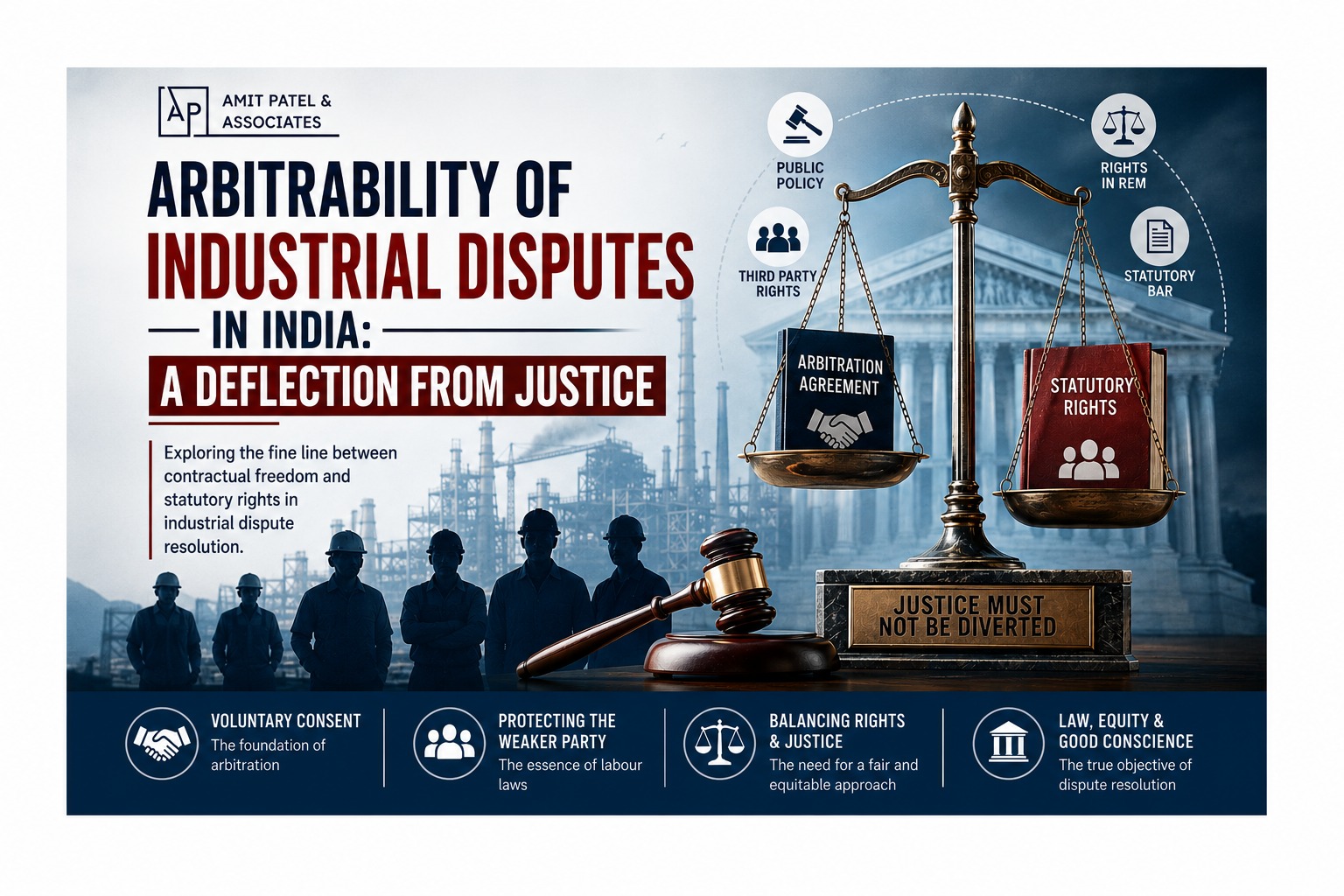
Arbitration has been one of the most preferred forms of alternative dispute resolution for various types of disputes arising out of a written contract, mostly involving, but not limited to, commercial disputes and consumer disputes. However, the Supreme Court in India has time and again limited the scope of arbitration relating to labour disputes, especially those involving public policy considerations, third-party rights, rights in rem, or otherwise deemed to be non-arbitrable.
What exactly is the concept of arbitrability/non-arbitrability?
The Arbitration and Conciliation Act, 1996, which is the central act regulating laws related to arbitration in India, recognizes that certain facts may not be subject to arbitration. Under the kompetenz-kompetenz principle, as also embodied under Section 16(1) of the Act, an arbitral tribunal has the power to decide whether it has jurisdiction in a case brought to it. Section 34(1)(b) lays down two grounds for setting aside an arbitration decree- first, if the court finds that the subject matter of the dispute is not capable of being solved by arbitration, given the law being in force at that time, and second, if the arbitral award conflicts with the public policy of India. Arbitrability, in the context of this article, therefore, refers to the question of whether an issue or a dispute is capable of being resolved through arbitration, or whether it falls within the scope of the arbitration agreement, since Section 7 of the Arbitration and Conciliation Act states that for a matter to be solved through arbitration, there has to be a written arbitration agreement, either in the form of an arbitration clause in the contract or a separate agreement altogether, specifying the intention of the parties to solved any or all of the dispute relating to their defined legal relationship to arbitration.
The Supreme Court has distinguished between arbitrable contractual matters and non-arbitrable statutory matters in several judgments, highlighting the fact that statutory matters are non-negotiable and have to be guaranteed in the public interest, while contractual rights depend on the consent of the parties to negotiate and work out their rights. In the case of Vidya Drolia v. Durga Trading Corporation, the Supreme Court laid down four parameters for holding a dispute as non-arbitrable:
- When the subject matter of the dispute relates to rights in rem, and does not pertain to rights in personem that arises from a right in rem, since right in rem was a right exercisable from the world at large and not amendable to arbitration, while right in personem is an interest protected against a specific individual and is referable to arbitration, as held in Booz-Allen and Hamilton Inc. v. SBI Home Finance Ltd. and ors.;
- When the cause of action and subject matter of the dispute affects third-party rights and requires a central adjudication and mutual adjudication might not be appropriate;
- When the subject matter is expressly or impliedly made non-arbitrable by requisite statutes;
- When it relates to sacrosanct sovereign and public interest functions of the state, which render the arbitral award unenforceable.
In the Booz-Allen case, certain types of matters were held to be non-arbitrable, which included matrimonial and guardianship matters, disputes giving rise to or arising out of criminal offences, tenancy or eviction matters, testamentary matters, and company law matters relating to winding up or insolvency.
In the 2010 case of Afcons Infrastructure Ltd. v. Cherian Varkey Construction Co., the court in para 19 gave a list of matters that could be referred to ADR mechanisms. It included the disputes between employees and employers and further said that the list is not exhaustive and rigid, thus, implying that other types of industrial disputes can also be referred to arbitration.
Statutory framework governing labour disputes in India
Industrial disputes in India are mainly governed by the Industrial Disputes Act, 1947. Under Section 2(k) of the Act, industrial dispute refers to “any dispute between employers and workmen or between workmen and workmen or between employers and employers, which is connected with the employment or non-employment or terms of employment or with the conditions of labour or with any other person”. Section 10A of the Act expressly allows voluntary arbitration after both parties agree to refer the matter to arbitration by a written agreement. As such unless the arbitration agreement includes right in rem, or against public interest considerations or is otherwise deemed to be non-arbitrable as per the four parameters of Vidya Drolia, such an arbitration agreement, wherein both parties agree to submit all disputes raised to arbitration, is valid and both parties are bound by it as per the general principles of estoppel, as held by the Telengana High Court in the case of Weiss Technik India Private Ltd. v. Ms. Bollupalli Madhalavilatha, which affirmed the limited intervention of the court in cases where the matter is agreed to be referred to arbitration. But on the contrary, many industrial disputes were held by the court to be non-arbitrable, in furtherance of public policy and right in rem considerations.
Judicial decisions on the arbitrability of industrial disputes
The scope of arbitration was initially narrowed in the case of industrial disputes since industrial disputes were believed to be not only private disputes but also something with the potential to have an impact on the whole industry in which the dispute arose, and thus, was classified as non-arbitrable due to public policy considerations. In the 2012 case of Kingfisher Airlines Ltd. v. Captain Prithvi Malhotra, wherein the Bombay High Court applied the four parameters of Vidya Drolia and held an otherwise private dispute between an employee and an employer as non-arbitrable since it could potentially affect other employees and subsequently, the industry as a whole. Further, the court differentiated between arbitration under the Arbitration and Conciliation Act, 1996, and that under Section 10A of the Industrial Disputes Act, saying that the former was largely party-driven and allowed the parties to choose the arbitrator and the forum of arbitration, while the latter was not entirely left in the choice of the parties as abjudication of industrial disputes in the exclusion domain of the authorities established under the Industrial Disputes Act, and thus, it was the implied intention of the legislation to exclude the scope of arbitrator in these types of cases.
In the Weiss Technik case of 2021, the court took a broader view and held that arbitration agreements, when voluntarily agreed to by the parties, are valid, and the court must not interfere except to appoint an arbitrator, where the parties are unable to decide one, and even in doing so, it cannot delve into the merits of the dispute, even if it involves an element of fraud since that is an arbitrable dispute. Previously, also, in cases like IBI Consultancy India v. DSC Ltd, the Supreme Court has held that where parties to a contract have already agreed to arbitrate the disputes, the court is required to decide only whether a valid arbitration agreement under Section 7 of the Arbitration and Conciliation Act exists or not exists or not.
In the 2024 case of Dushyant Janbandhu v. M/s Hyundai Autoever India Pvt. Ltd., the court held that disputes regarding non-payment of wages and legality of termination, when pending before statutory authorities are non-arbitrable since while the former falls within the ambit of Section 15(2) of the Wages Act, the latter falls under Section 2A of the Industrial Disputes Act and hence within the domain of industrial tribunal, and therefore, are non-arbitrable since matters where arbitration is expressly or implied barred by statute are non-arbitrable.
In another 2024 case of Lily Packers Pvt. Ltd. v. Vaishnavi Vijay Umak and Ors., the Delhi High Court held that the validity of the lock-in period and employment disputes related to such negative covenants are arbitrable under Indian laws.
Public policy considerations of making it a statutory right, vis-à-vis the disadvantages of making it arbitrable
One of the key features of arbitration in respect of contracts is the equal bargaining power of both parties, which, agreeably, is absent in the case of industrial disputes. Due to this, the labour laws were enacted to ensure that the rights of the weaker party are protected and they are not exploited under the capitalist system. This might lead to a situation where the weaker party is subjected to a standardized arbitration clause and then bound by it, if all kinds of industrial disputes are made arbitrable. Such a situation would be highly unbalanced and would adversely affect the weaker party. Further, arbitration, although it provides a quicker and more efficient resolution, incurs high costs, knowledge of foreign jurisdiction and institutional rules, which might not always be possible for the weaker party, especially the workmen who often work on daily wages, just enough to sustain their families. The average cost of appointing an arbitrator in India can go up to Rs. 5 lakhs, which an average workman or an employer running a small organization cannot be expected to give. Moreover, if one party is stronger, they will have more say in appointing the arbitrator, which will reduce the transparency of the arbitration process to a great extent and, hence, defeat the very purpose of arbitration.
Section 4 of the ID Act empowers the appropriate government to appoint a conciliation officer for the settlement of industrial disputes, thus providing a statutory ADR mechanism to the parties before approaching the court.
Conclusion
Arbitration, though a very flexible and efficient procedure, is not a feasible option for industrial disputes, especially those involving the statutory rights of individuals, which are non-negotiable and guaranteed under Part of the Constitution of India, which was one of the predominant reasons for the enactment of the Industrial Disputes Act. However, with the emergence of hybrid dispute resolutions like mediation-arbitration and attempts of international jurisdictions to integrate arbitration with the prevention of unfair labour practices, developments in India’s arbitration mechanism remain to be seen, with possible reforms focusing on fair rules and prevention of unilateral imposition in voluntary arbitration agreements.
By Anwesha Nayak, final-year student at the Institute of Law, Nirma University.
Need Legal Assistance?
If you need help with legal matters, our experienced team can guide you through the process and protect your rights.
Contact Us